What if seven simple words could completely change the way you live?
Not motivational slogans designed to give you a temporary rush. Not generic positive affirmations you repeat in the mirror. Instead, imagine seven ancient Japanese concepts—each one representing a deeply rooted way of thinking, being, and acting that has quietly shaped daily life in Japan for centuries.
In our fast-paced, high-stress Western world, we are constantly told to do more, be more, and fix everything instantly. But these seven philosophies offer a completely different path. They are practical, quietly powerful, and deeply transformative. By understanding even just one of these ideas, you can fundamentally shift how you experience your home, your body, your relationships, and your time.
It is no secret that Japan consistently ranks among the healthiest, longest-living, and most content populations on Earth. The secret behind this isn’t geography or genetics—it is philosophy made practical. It is the daily habit of using timeless ideas to guide how they eat, work, rest, and navigate hard times.
In this guide, we are diving deep into all seven of these whispers of wisdom. You will learn exactly what each concept means, why it works so beautifully, and how you can seamlessly bring it into your daily routine starting today. Whether you are seeking a calmer lifestyle or an immersive way to practice your English reading skills, let’s begin this journey together.
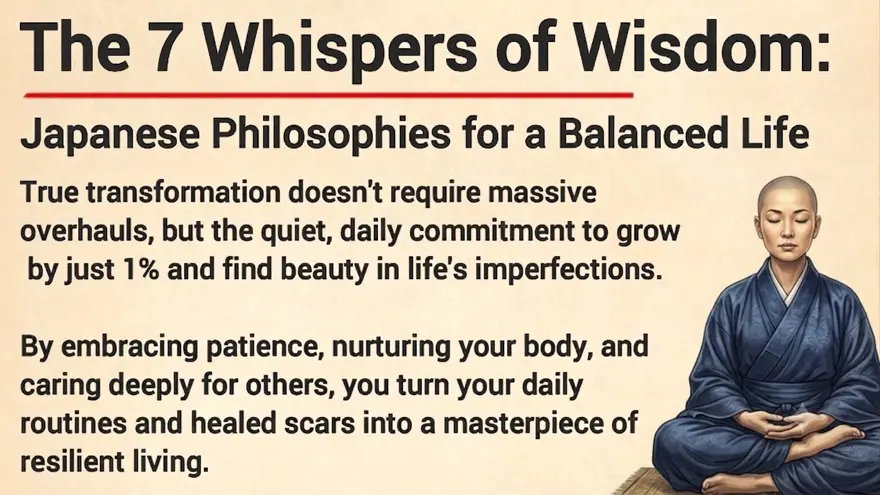
The Seven Whispers of Wisdom: Japanese Philosophies for a Balanced Life
What if just seven words could completely change the way you live your life?
These are not the typical motivational slogans you see on billboards. They are not positive affirmations you shout in the mirror. Instead, they are seven ancient Japanese concepts. Each one represents a deeply rooted way of thinking and acting that has shaped daily life in Japan for centuries.
These seven philosophies are quiet, practical, and incredibly powerful. For many people living in the fast-paced Western world, they might seem completely opposite to how we usually run through our days. But understanding even one of these ideas can deeply shift how you experience your home, your body, your relationships, and your time.
Japan regularly ranks among the healthiest, longest-living, and most truly content populations on Earth. The secret behind this isn’t found in their geography or their genetics. It is found in their philosophy made practical. It is the daily habit of using ideas to guide how they eat, how they work, how they rest, how they handle hard times, and how they connect with the world.
Today, we are exploring all seven. You will learn what each word means, why it works so beautifully, and exactly how to bring it into your own life starting right now. Some of these ideas will feel familiar. Some will challenge the way you think. All of them will change you.
Let us begin.
See video Here: https://youtu.be/7OXA-yAcbDQ
Chapter 1: Kaizen — The Power of the One Percent
Many people in the Western world have heard the word Kaizen, but almost everyone misunderstands it. We often view Kaizen as a strict business tool—a corporate strategy used to increase productivity, speed up manufacturing, or boost profits.
But in Japanese daily life, Kaizen is deeply personal. It is a gentle, patient understanding that real transformation never comes from a sudden, dramatic overhaul. True change comes from the quiet, relentless accumulation of tiny improvements made consistently over time.
The daily habit of Kaizen is simple: Every single day, find just one thing that you can do slightly better than you did yesterday.
Do not try to make it dramatically better. Aim for just 1% better.
-
It could be the way you organize a single drawer.
-
It could be the care you put into preparing a single meal.
-
It could be the peaceful way you start your morning, or the kind way you speak to a coworker.
Just one thing. One percent. Every single day.
The math behind Kaizen is absolutely staggering. If you make yourself or your life just 1% better every day for one full year, you will end up 37 times better than where you started. You don’t achieve this through heroic, exhausting effort. You achieve it through the quiet, steady application of the smallest possible improvement, repeated until it grows into something extraordinary.
In your home, Kaizen means you don’t spend your entire weekend completely reorganizing your house until you are wiped out. Instead, you improve one small corner today. You fix one small habit tomorrow. You keep going, day after day, until the quiet pile of those tiny changes completely transforms your space, your habits, and your entire life.
Chapter 2: Gaman — The Dignity of Endurance
There is no single English word that can perfectly translate Gaman. This missing word reveals a fascinating cultural difference between how different societies view hard times.
Roughly translated, Gaman means enduring the seemingly unbearable with patience, dignity, and self-control. It is the practice of facing discomfort head-on—not by suppressing your feelings, and not by pretending everything is fine, but by meeting the challenge with a calm mind and continuing to step forward.
In daily life, Gaman shows up in quiet, significant moments. It is:
-
The choice not to complain about minor inconveniences, like a long line or bad weather.
-
The patience to push through the awkward discomfort of a new habit until it feels natural.
-
The discipline to sit with a difficult, unfinished task instead of walking away the moment it stops being fun.
You can easily use Gaman in your daily routine. Whenever you try to start a new habit, it will feel uncomfortable at first—that is just how human brains work. Gaman is the bridge that carries you from that initial discomfort to the point where the habit becomes automatic.
Instead of looking at the discomfort as a sign that you should quit, Gaman teaches you to see it as proof that you are growing. You endure it with dignity. You keep going. And right on the other side of that tough moment is a smooth, automatic behavior that no longer takes any effort at all.
Chapter 3: Wabi-Sabi — The Beauty of Imperfection
We live in a world obsessed with flawless filters and perfect lifestyles. Wabi-Sabi is the beautiful antidote to that pressure. It is the Japanese aesthetic philosophy of finding deep beauty in imperfection, impermanence, and things that are incomplete.
Wabi-Sabi reminds us of three simple truths: nothing lasts, nothing is finished, and nothing is perfect. Crucially, it teaches us that these things are not flaws to be fixed; they are natural truths to be loved and embraced.
In our homes, practicing Wabi-Sabi brings immense freedom. It gives you permission to finally stop waiting for everything to be perfect.
-
It is permission to love and use a beautiful ceramic bowl even if it has a tiny chip on the edge.
-
It is permission to see your home as genuinely lovely and cozy, even when it doesn’t look like a spotless picture from a magazine.
-
It is permission to stop the exhausting, endless race toward perfection.
To practice this daily, try this simple habit: Once a day, find one imperfect thing in your life and intentionally appreciate it instead of wishing it were different.
Look at the worn, smooth edges of a favorite wooden chair. Notice how wild and alive your garden looks right after a heavy rain. Taste a meal that didn’t turn out looking like the recipe photo, but still nourished your family. In the lens of Wabi-Sabi, these are not failures. They are the beautiful, authentic marks of a life truly lived, a home truly loved, and a person truly human.
Chapter 4: Kintsugi — Repair as an Art Form
Imagine a precious ceramic bowl slips from your hands and shatters on the floor. In many places, that bowl would be swept up and thrown in the trash. But Japan has a different tradition called Kintsugi, which means “to join with gold.”
Instead of throwing the broken pieces away, or trying to glue them back together with invisible, hidden seams, a Kintsugi master repairs the cracks using a special lacquer dusted with pure, shining gold. This process makes the broken lines highly visible, stunningly beautiful, and a proud part of the object’s history. The bowl becomes more valuable because it was broken, not despite it.
As a philosophy for your life, Kintsugi asks you to treat your own emotional and physical breaks the exact same way.
-
Think of the relationship that went through a major storm but survived and grew closer.
-
Think of the painful period in your life that felt like it shattered your world, but from which you eventually stood up, changed.
-
Think of a dream that fell apart, forcing you to creatively rebuild your life from scratch.
Kintsugi tells you that these hard times are not chapters of your story you should hide in shame. They are your golden lines. They are the exact places where you were tested, where you healed, and where you became far more beautiful, resilient, and interesting than you ever were before the break.
The habit here is to stop hiding your struggles and start honoring your healing. When you survive a difficult season, acknowledge it. You don’t do this to feel sad about the past; you do it to respect the strength it took to put yourself back together. Your cracks are not your weaknesses. They are your gold.
Chapter 5: Hara Hachi Bu — Eat Until Eighty Percent Full
Hara Hachi Bu is an ancient teaching practiced every single day in Okinawa, Japan. Okinawa is one of the world’s famous “Blue Zones”—places where people naturally live incredibly long, healthy lives, often passing the age of 100.
The phrase translates to a very simple rule: Eat until you are 80% full. Stop eating right before you feel completely satisfied. Leave a little bit of space between where you currently are and the absolute limit of your stomach’s capacity.
There is fascinating science behind this ancient habit. It takes about 20 minutes for your stomach to send signals to your brain letting it know that you are full. If you keep eating until you actually feel stuffed, you have almost certainly overeaten, because your brain is receiving the message too late.
By intentionally stopping when you feel about 80% satisfied, you give your body time to catch up. Twenty minutes later, you will realize you feel perfectly energized and light, rather than heavy and tired.
The daily habit requires you to slow down and be present. Eat slowly enough to actually taste your food and notice how your body feels. Try putting your fork down between bites. Pause halfway through your meal and check in with your stomach, rather than automatically clearing the plate just because the food is there. The size of the plate is not the boss of you. Your body is the true measure.
Chapter 6: Shinrin-Yoku — Forest Bathing
The words Shinrin-Yoku literally mean “Forest Bathing.” However, this does not mean you need to go for a strenuous hike, put on exercise gear, or travel to a distant wilderness. It is not about fitness or reaching a destination.
Instead, Shinrin-Yoku is the peaceful practice of spending time in a natural environment—whether that is a deep forest, a local city park, or a quiet backyard garden—and slowly, quietly opening all five of your senses to the world around you.
The scientific research supporting Shinrin-Yoku is vast and clear. Spending quiet time wrapped in nature significantly drops your body’s stress hormones, lowers your blood pressure, boosts your immune system, eases anxiety, and lifts your mood. Amazingly, the positive health effects of a single session can last in your body for days afterward. The Japanese government even officially lists Shinrin-Yoku as a pillar of preventative healthcare.
You don’t need hours to reap these rewards. Just 20 minutes is enough to change your biology.
Here is how to practice it: Once a week, step into a green space. Leave your phone behind in your car, or turn it off and keep it deep in your pocket. Spend 20 minutes just being there. Don’t power-walk for exercise. Don’t sit on a bench and check your messages. Simply notice. Look at how the sunlight filters through the leaves. Listen to the wind. Smell the soil. Feel the temperature of the air on your skin. That is forest bathing, and it is medicine for the soul.
Chapter 7: Omoyari — Anticipatory Empathy
Our final concept, Omoyari, is one of the most beautiful gifts Japanese culture offers the world. It translates to the ability to anticipate the needs and feelings of others, and to act on them before being asked.
It is empathy turned into action. It is the habit of looking at the people around you and wondering: What will they need next, and how can I take care of it for them right now?
In Japan, Omoyari shows up in quiet, beautiful ways that make people feel deeply cared for:
-
A host places comfortable slippers by the door before a guest arrives, knowing they will be tired from their long journey.
-
A family member quietly makes a warm cup of tea and sets it down next to someone who is about to start a difficult day of work.
Bringing Omoyari into your home can completely change the tone of your relationships.
-
Before your partner walks through the door after a hard day, think about what they might need—perhaps a calm kitchen, a warm smile, or a simple snack ready to eat.
-
Before the morning rush starts, look ahead and help your child prepare their school bag the night before to save them from morning stress.
-
Before a guest even has to ask for a glass of water, you have already poured it and set it down.
Omoyari shifts your mind from being reactive to being thoughtfully proactive. The feeling of being truly seen and cared for—before you even have to open your mouth to ask—is one of the most comforting gifts one human being can give to another. It costs absolutely nothing. It only requires you to look just a little bit ahead into the next moment, and warmly prepare the way for the people you love.
Moving Forward: The First Step
Seven words. Seven paths to a calmer, more meaningful life.
-
Kaizen reminds us to grow by just 1% every day.
-
Gaman teaches us to face discomfort with quiet dignity.
-
Wabi-Sabi invites us to find peace in things that are imperfect.
-
Kintsugi shows us that our healed scars are beautiful lines of gold.
-
Hara Hachi Bu protects our health by telling us to stop before we are full.
-
Shinrin-Yoku opens our eyes to the healing medicine of the natural world.
-
Omoyari guides us to care for one another gently, ahead of time.
None of these concepts require you to spend money. None of them demand hours of free time. They only ask for a single, quiet decision: to choose just one concept today, and apply it to your life in the smallest possible way.
That single, small choice? That is Kaizen. And that is exactly where a beautiful life begins.
🙋♂️ Frequently Asked Questions
Q1: Do I need to practice all seven philosophies at once to see a difference?
A: Not at all! In fact, trying to adopt all seven at once goes against the very spirit of Kaizen (small, gradual changes). The best approach is to choose just one concept that speaks to your current situation—whether that is finding beauty in a messy home with Wabi-Sabi or eating mindfully with Hara Hachi Bu—and practice it for a few weeks before exploring others.
Q2: What is the main difference between Wabi-Sabi and Kintsugi?
A: While both celebrate flawlessness, they apply to different states of life. Wabi-Sabi is a broad aesthetic and lifestyle philosophy about accepting the natural wear-and-tear, impermanence, and imperfection of everyday things. Kintsugi is a specific philosophy of healing and repair; it focuses on how we rebuild ourselves after a major crisis or “break” and treat those scars as beautiful history.
Q3: I live in a crowded concrete city. How can I practice Shinrin-Yoku (Forest Bathing)?
A: You don’t need a massive, deep forest to practice Shinrin-Yoku. A local city park, a botanical garden, or even a quiet backyard with a single tree and some bushes will work perfectly. The key to the practice isn’t the size of the forest—it is turning off your phone, slowing your pace, and actively using your five senses to connect with whatever nature is available around you.
Q4: Isn’t “Gaman” just suppressing your emotions and staying quiet during hard times?
A: It is a common misconception, but true Gaman is not about emotional suppression or denial. Denying your pain is unhealthy. Gaman is about emotional maturity and composure. It means fully acknowledging that a situation is difficult or uncomfortable, but choosing to meet that challenge with dignity, patience, and a calm focus on moving forward rather than letting anger or complaints take over.
Q5: How can I teach my children the concept of Omoyari?
A: The best way to teach Omoyari (anticipatory empathy) is through modeling and gamifying small daily moments. You can ask your children forward-looking questions like, “Grandma is coming over after a long flight; what do you think her body will feel like, and how can we make her room cozy before she gets here?” This gently trains their brains to look ahead and consider the comfort of others.
✒️Conclusion
Seven words. Seven distinct paths to a calmer, more resilient, and deeply meaningful life.
When you look closely at these timeless philosophies, you realize they don’t demand heroic, exhausting effort. Kaizen asks you to improve by just 1% today. Gaman teaches you to carry yourself through discomfort with dignity. Wabi-Sabi gives you permission to find peace in things that are imperfect, while Kintsugi beautifully reminds you that your healed scars are made of gold. By practicing Hara Hachi Bu, you honor your body; through Shinrin-Yoku, you let nature heal your mind; and with Omoyari, you gift the people you love with the ultimate comfort of being anticipated and seen.
None of these concepts require money, and none of them require hours of extra time. They only ask for a single, quiet choice: to pick one concept today and apply it to your life in the smallest possible way.
That tiny, intentional step forward? That is Kaizen in action. And that is exactly where your new, balanced life begins.
💬 Let’s Chat!
Which of these seven whispers of wisdom resonated with you the most today? Are you going to practice the 1% rule of Kaizen, or perhaps try a little Wabi-Sabi in your home? Drop a comment below and share your thoughts—I love reading your insights! Don’t forget to subscribe to the blog for more mindfulness and storytelling guides.
